Why Run a Mobile-Network Throttling Drill? Is There Any Point?
Taiwan ranks among the world’s best for mobile data pricing, connection speed, and connection quality. That is the fruit of years of construction and maintenance by the three major telecom operators and the government, and it is why the public enjoys a mobile network environment that is both stable and inexpensive.
Taiwan is also, however, a country where typhoons and earthquakes are frequent. Beyond damaging water supply and the power grid, natural disasters also reach network and communications equipment such as base stations and cables: the magnitude 7.2 Hualien earthquake of April 3, 2024 affected 172 mobile base stations at its peak (mostly concentrated in the Yilan–Hualien area)[1]; in July 2025, Typhoon Danas put more than 1,300 base stations in and around the Chiayi–Tainan area out of service through power loss or damage[2][3], and some of them were not fully repaired until the end of October that year[4]. A mobile network outage does not just make it hard for residents of a disaster area to reach family and friends; it also obstructs the coordination of relief work.
It is worth noting that damage to base stations mostly produces a “localized outage,” whereas damage to Taiwan’s international subsea cables could produce an “island-wide slowdown”: the core servers of many everyday apps and websites sit overseas, so once international bandwidth drops sharply, services will still stall badly even when the domestic network is working normally. The “Digital Resilience Forum: Subsea Cables and Network Infrastructure in an Age of Geopolitics”, held by Cyborg Resilience Co-lab (CRC) on March 25 this year, ran a simulation and analysis of exactly this kind of partially damaged network scenario[5]; one of its conclusions at the time was that “drills, whether run by government or by civil society, need to include scenarios in which the network is damaged.”
The government has long promoted disaster prevention and relief education and evacuation drills, so that people become familiar with response procedures before a disaster arrives and build the capacity to handle sudden situations. The core of disaster mitigation (and prevention) is to reduce the impact of natural disasters on daily life as far as possible; as everyday life grows more dependent on the internet, “network slowdown or outage” should be brought into drill scenarios too.
Drills of this kind, dealing with networks and communications, are not unprecedented internationally: the “Council for Emergency Communications” (Japanese: 非常通信協議会), formed by Japan’s Ministry of Internal Affairs and Communications together with telecommunications organizations, regularly runs “emergency communications training,” in which disaster information is relayed over backup power and alternative communications circuits when public lines and disaster-prevention radio are down[6]; South Korea’s 2025 “Ulchi exercise” (을지연습) mobilized roughly 4,000 agencies and 580,000 people, with scenarios covering not only communications outages and destruction of network infrastructure but also GPS jamming[7]; and NATO’s Cooperative Cyber Defence Centre of Excellence (CCDCOE) holds Locked Shields, the world’s largest live-fire cyber defense exercise, in Tallinn, Estonia every year, mobilizing 41 nations and more than 4,000 people to practice defending critical infrastructure, including scenarios in which communications infrastructure is destroyed[8].
Finland has gone further still: for nine consecutive years the Digital and Population Data Services Agency (DVV) has run the nationwide “TAISTO” cyber and information security exercise, open free of charge to every public-sector organization, with more than 450 agencies and institutions taking part in recent editions; working with the police and national security agencies, it simulates scenarios such as cyberattacks, systems being hacked, and even AI information security[9].
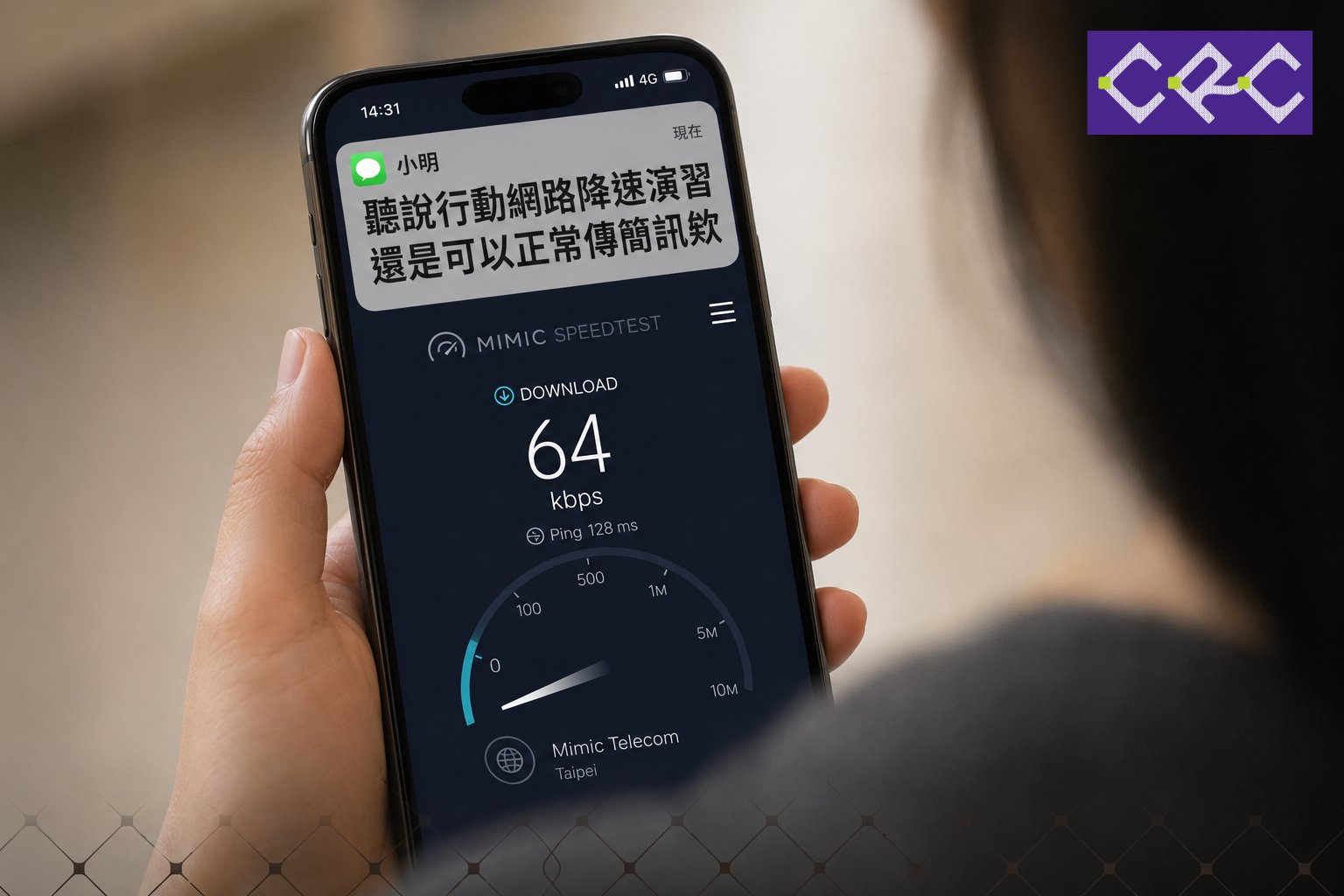
This year’s Urban Resilience Exercise includes a “mobile network throttling” drill for the first time: starting at 2:30 pm on August 10 (7 central counties and cities) and August 13 (7 northern counties and cities), it simulates the shortage of bandwidth that follows the activation of disaster roaming and tiered traffic limiting, throttling speeds for 30 minutes; voice calls, SMS, Public Warning System cell broadcasts, and emergency numbers such as 110 and 119 are all unaffected, and Wi-Fi running over fixed broadband is unaffected as well[10]. The public can use the occasion to practice alternatives such as offline maps, cash payment, and reaching people by phone number, preparing in advance for the natural disasters that may come.
We are glad to see this item added to this year’s exercise, and we hope future exercises and disaster-prevention education will keep broadening and deepening scenarios related to digital resilience!
With half a month to go before the exercise, CRC will share next week how to prepare for the “mobile network throttling” drill. We’d love for all you brilliant people to leave a comment and share what you, your family, or your friends have already arranged for this one~~
References
- Central News Agency, “Strong quake affects 172 base stations across the three major telecom operators; NCC estimates repairs today,” April 3, 2024.
- Executive Yuan, “Typhoon Danas response measures and recovery status” (figures as of July 9, 2025; 1,360 base stations damaged).
- United Daily News, “Typhoon Danas devastates communications in Chiayi–Tainan; NCC activates disaster roaming to avert digital isolation” (1,293 base stations in southern Taiwan knocked out by power loss or damage).
- Central News Agency, “Typhoon Danas devastates base stations; Chunghwa Telecom: restoration scheduled by the end of October,” August 4, 2025.
- CRC Cyborg Resilience Co-lab, “Digital Resilience Forum: Subsea Cables and Network Infrastructure in an Age of Geopolitics”, March 25, 2026.
- Council for Emergency Communications (非常通信協議会), 非常通信確保のためのガイド・マニュアル.
- 이치저널, “드론과 GPS가 멈춘다”… 전 국민이 훈련에 들어가는 3박 4일, 2025 을지연습, August 2025.
- NATO CCDCOE, “Locked Shields.”
- Digi- ja väestötietovirasto (DVV), “TAISTO-harjoitus”; see also the DVV press release.
- Central News Agency, “Urban Resilience Exercise: phones throttled, not disconnected, across 14 counties and cities — the affected scope explained in one read,” July 21, 2026.