DSET Coverage: Comparing Taiwan’s and Ukraine’s Cyber Defense Experience
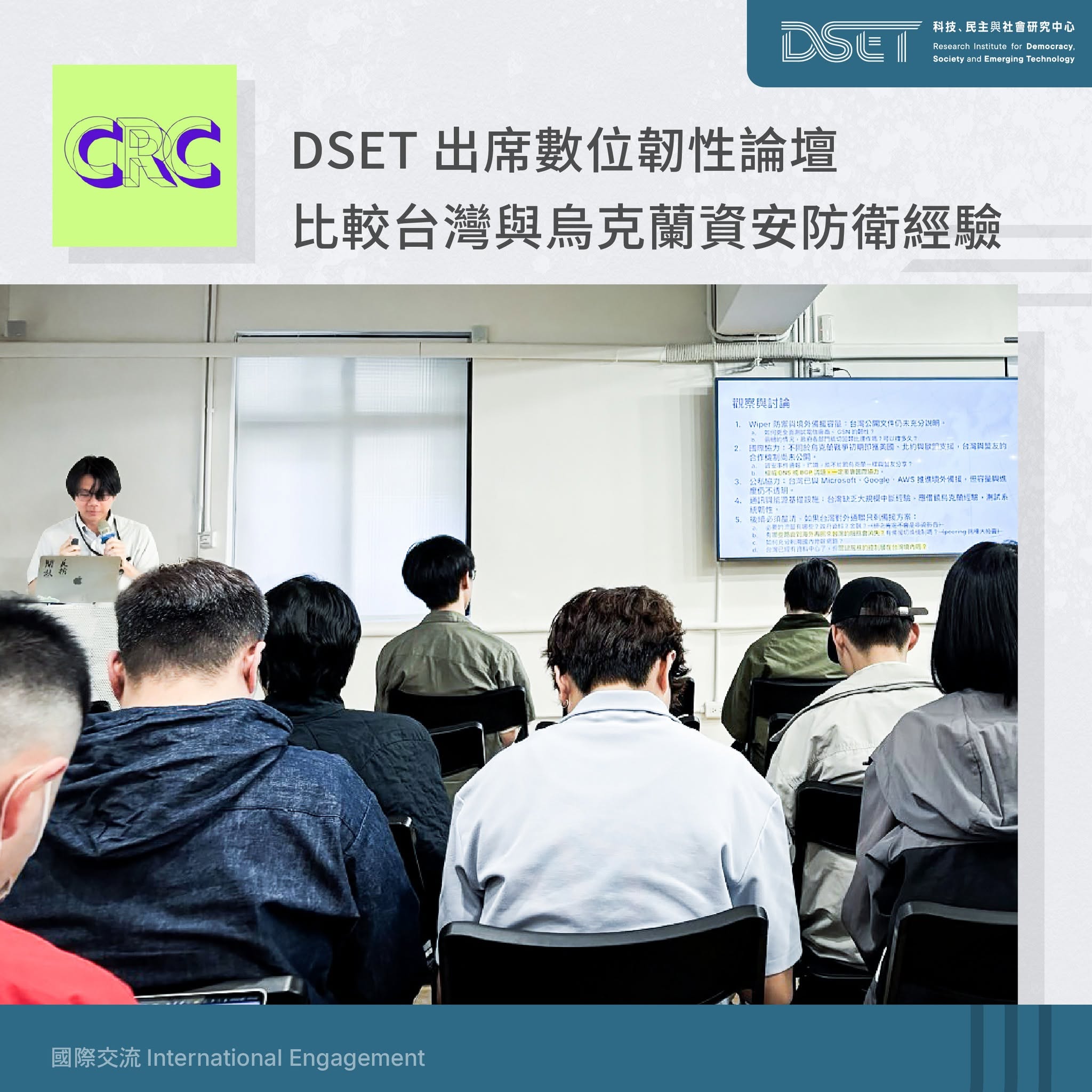
On March 25, DSET Adjunct Research Fellow Jen-Wei Chang represented the institute at the “Digital Resilience Forum,” organized by Cyborg Resilience Co-lab (CRC) under the theme “Subsea Cables and Network Infrastructure under Geopolitical Pressure.” He shared experience from #Ukraine’sWartimeCybersecurityAndCommunicationsOperations and offered policy recommendations for Taiwan.
This Digital Resilience Forum was jointly advanced by communities including Cyborg Resilience Co-lab (CRC), g0v.tw Taiwan Zero Government, and the Open Culture Foundation. It was moderated by CRC co-founder Meichun Lee and Open Culture Foundation CEO Hsin-Ying Lee. DSET participated in the forum’s second session, joining representatives from the Institute for National Defense and Security Research, the Ministry of Digital Affairs, and civil technical communities to discuss digital resilience.
Drawing on cases of wartime cyberattacks in Ukraine, Jen-Wei Chang explained that digital resilience is not improvised only after a crisis begins; it is grounded in ordinary network infrastructure and the capacity for rapid wartime coordination. He said that Ukraine not only has a more diverse network structure and cross-border interconnection conditions, but has also kept critical communications operating during the war through measures including #NationalRoaming, #SatelliteBridging, #EmergencySpectrum, #BackupPower, and #ContinuousRepairs. The latter combined-response approach is especially worthy of Taiwan’s attention.
He further noted that although Starlink is important, it is not a stand-alone solution that can operate independently of existing infrastructure. Taiwan’s urgent priority is to build a national network architecture that is multilayered, uses multiple providers, and can allocate resources by priority level, while taking stock of risks involving coordination across operators, routing sovereignty, and domain governance.
Because Taiwan relies heavily on subsea cables for international communications, core issues that must be clarified early include maintaining priority for essential traffic, service outages that overseas rerouting may cause, and whether critical control layers can operate independently within Taiwan. Communications governance issues involving DNS and BGP also require international cooperation. Incident reporting, forensic collaboration, and overseas backup mechanisms between Taiwan and its allies still need further institutionalization and transparency.
Jen-Wei Chang said that Taiwan’s next step should place “continuous operation” at the heart of digital resilience, strengthen redundancy at critical nodes, and use combined exercises across agencies and operators to transform international experience into locally viable solutions.
(This article was written and compiled by DSET.)